Footguns Beware 2: Auth0 + Next.js
Mess with the props, your tokens get popped!

Background
Fresh off of a recent test, I found another interesting footgun which I thought I’d share. It is somewhat similar to the last post where server-side information gets exposed on the client-side but the nature of it is completely different!
This time the behavior is easily reproducible, but is not very widespread – nevertheless I hope you enjoy the read and can takeaway something useful from this blog!
Note: Frameworks are huge beasts that cannot be fully explained in a single blog post, so I have only included the information relevant to the footgun in this post.
What is Auth0?
Auth0 is an identity and access management (IAM) platform that handles user authentication and authorization for your applications. Instead of building and maintaining your own login system, you integrate with Auth0, which manages user sign-in, single-sign on, multi-factor authentication, session management, and token issuance. After a user successfully authenticates, Auth0 returns signed tokens or session information that your application uses to identify the user and enforce access controls. -ChatGPT
The appSession cookie returned to each user upon login is a stateless, encrypted cookie created by the Auth0 Next.js SDK (@auth0/nextjs-auth0) or other server-side Auth0 SDKs to track user authentication locally.
Most importantly, it is marked as HttpOnly, Secure, and uses SameSite=Lax by default; therefore, any JavaScript running in the browser cannot read or modify it.
1
eyJhbGciOiJkaXIiLCJlbmMiOiJBMjU2R0NNIiwiaWF0IjoxNzgzNTE5MDcwLCJ1YXQiOjE3ODM1MTkwNzEsImV4cCI6MTc4MzYwNTQ3MX0..OHizOUTpD-gv4jWe.6SF_5SDlJBTnyENdhQKznPkDYP4LeDw3o-pG3jNoNVQx4Ic0Lw-2InJu4CeYyHzzbMPlT7kl569_EalZOZ-P3BQev_GGE8nBnyFGJ7cd0qRbZTbG9t9Ta0Fo1OJhEiUBWl_gqrBlNq_WGAc3P8163ap8Sw0aDfZ1O-khIVB_ZrdnkQ9nBGas192piG18qaVPSLI4Woa36fj4W_AhtWYJZqaNpLmI7Trjf2LdTC6cNZ0jrZ7yMyH5BI3SuvhJ6IMLFFh_FCd_uJNnP14hP-JP1NMAhd4-BXGBK0jLgw_8oN_ApR0iYR03FcSgyQEDkqkoT8hcun4dMtk5_7mZsPFfjR6uxSXzy9vt7SppN-EMBdXii3Lhq6sSWTnfbLIHS0vntE7Vk_iz1slJ0gvEU_1TWP5ikTZpHlN76QdbCBS4A3y6s5_hITJ3BjJL6tTaYrUMFlEMjzMuVisLIzdvxz7KEmHdZDkdPQHBgh_GzWG7tHEgd3BeVb4gq3o1kSAQGzbjjMupQ6NTT8scjXN4uhzuAoBTg21LlqZQ_E0NqYflTe9YzMIUBPEW56e9gX9qbQj8de4HxU39ok67N0OTEWdCCGEoBPW45VcF25eQgyDQpwcCmTkraD8uYE9tR2FUqfAO9Q017NgMeA8Ejh_31hRuoTvyW6A5mxc_y6W8R3wgi6pKiK-rEefHx-k4X9foROg2V87ZuB7jEh5jKEPMMfLrXFONbc2iCUBrv5hgSv-bV-BcOgCmAWUZ1hJWYg0GiT1XVk45BRvOqBYp4aEnaVfvUjTSlKhADMueVS8wP-fgaEbk13RVu6k13cMTh_9vfuW1hv6nOVDVozalu04JuftjmFX2h0CRN0WCwLva58PlY0-hsXaNmPDaYgWsKhFURLK89fDplAJuKVgEhrPPaWqjtDaRhdN-WAPdF8ho9Ad3MW2YZ-ZhjjYDgARZf5_8ZPSjZawQsMpGi6toBkR-rLLQhN8-FtgvBoHl-MA5SVOsWODdHdAx2xyIPd697ZRooFkf-mjOzjtjbwepeBETmVSvE-XOUj3e0jg8e9C88qS32Z2RLmnrb4EZA1QFXxsBPD13JeiHGaVmPZ2GArU4vnZswQ4s5Migaif1MXEzY-dxQEWFptq9dIbzWEQks2e8BiQj_saGv3xlC08FVz3fvzP9x9KXmbGYGkpbtn3RBHwAy0y-kUvgkEUSqOMXd9iIVCzyXMVlv1HetZ6LNSCdD2dWmyTgaNlNDAzdJMjtJCDo4EtSpHx-_YMo7OPmjJRztkguv3lvGDQNID_t8PvW6zoypcEJu3ZAb2Q7MW8-V4oqOurerTL5X6WXu5i4YjPzsbYDM-upvr4WUqO_KlHNxIFzLL9RjYtQ63JKtkaUZY6uaSBMgvAE1k-fgUxDF730ASr9tpKICbR-O_Le-Z_0UY3eg14gBuVH3zjGk_A_iibpd4JVCHd9SoDoovT91t6T823ZHuwxDy4dTRmiZPEoqB_5Lr5zwv9anFjv6veMQNzpEy0E3z7rjbf0oifM2aa7BwmBoDw83g1D5x_VBmxCtS9YtP6PD7KBce-pXVypKITc_nLXuWaLBMIzBcxcxcdnAEezOaieTcoGKZNr-KR0ZbuGKCh6f2WAYNnKC3ESIqgn7ktbk4hhSFbO7AOuiONKFlJ2McPDUgnW4jfrfwJ0hdHGuzVm_fcryajZH5UMq88jNATNmRj2yfgWT9ZwnkZOHa99zb6RA_iCHyDhccFQSxXJ0iaExfrnuxy3fJ3fMKjlG7RjZfHWY53ayTBmxQYxKEKW0zrYJRYFVfAtO4rlx_ufvHt_GmVa2-zQS81GFnb7X3VTMXwRRCtGqd-sYjF6ZMlLhx8P2fOtpPXVEm4psGt1mG54MOhrSJ-ABxTl3oL8CfGTd7mPXOkou-QondlKh2usJlkD43wdzn9b4TiumgvXlk4h6llX3Rd2jvYFlemjoUJmIKOlI3OJ4FrJDlPfveOBbB7b6v4xzCjkzDifIHo-9mLMulCe2K1x_j7871_b2dc7KOEjnxj424wFXTXRzT_i6lFDC85Nr4ddrZ75Iow9WZLvuTPDaZJPZVwS_Q07Q1U01ITQo3FfDy25pVImj5TArj9oR3V8MFReK18LoKIRNghylN3Nx0_eMgDXVpLAENHf5VeoRFPSwNtGT_NKBmw7d-LeSjuy1MJ78LOe3WGkklX2OWMFIr-r5sdao1Ikz6H3HBb1E9Ya_GryL2ar6MW59O6uqTwdO3rPb_vjvIYzz3GTxWtwK_p4sCGDFJYUgTGUgmyiwH1BW-pPsVRN0iemeeZ4ICeZ-5FoCR2fqW4Hm039ITkQExv0X45UO3mqbqI4_kWonLcAVXX5F8SeSlFJ3XbHTlP1rPybC2iLA4_Wu3sPM0uqdW97u3Fo8ohYfa7bJomDYborHaBdkL2YIMgJ1ji3A8GqqsEWfF2DyYO225MFV-Qq6BBzJMmgpbj6VHF5w7n6VnVErh1kED4bPX1_9GnZUt5hB4OfdMQJHcVmB3s_hag7p6XEzAuok7ptstw-MsYAgDeLeE3tXwNsZLdsapWwIb1W9-4pTbihyio_qpoCaeh_fWMd8S2A5ajWTwWX3LrbhVt5hDsDIg7iK7YlZKR1utcknGgVBBPgsnnOIj79nkcHUhb2GC7ZU2LJXhPW3XwTP3Na0R8TtM66suXL6cprw-RW14Z6V-EvpTfr_Nv5LmES9gIU8vwB9nN_httR2NGGPf4glg4_IC_YPOtUdLYwwEXkHAMnngzfzOZdbcOba0lZy7gnAfcF2CNhI68rKkJye5PGPLhoWdkXEzbtE8zob8zrZSGePuEpOrnx6h42pQQN6R2FG4O8FJT6ktc.TIgwFTFh15qFlW0JoxT3hQ
It stores the user’s ID token, access token, refresh token, and profile data right inside the cookie. To prevent decoding or tampering, it is completely encrypted using the AUTH0_SECRET.
What is Next.js?
Next.js is a React framework for building full-stack applications, providing a structured way to develop both client-side and server-side functionality. Next.js provides a cohesive framework that handles routing, rendering, bundling, and deployment while still allowing you to build applications using React components. -ChatGPT
Props are components used to pass values from parent components to child components. In Next.js, it is possible for server-generated data to be passed into the client-side as props too!
Hydration is the process where:
- The server sends HTML to the browser.
- Next.js also sends the serialised props (typically as JSON embedded in the page).
- The browser loads the React JavaScript.
- React uses the same props to recreate the component tree and attach event handlers to the existing HTML.
The Pages Router pattern (now considered legacy to App Router) has a file-system based router built on the concept of pages. When a file is added to the pages directory, it becomes automatically available as a route.
The client’s application leveraged this pattern which essentially dictated that:
- The repository structures its pages into a
pagesdirectory - There will be a special
_app.xxxfile within thispagesdirectory (explained further) - There will be an exported Custom App function which handles all pages
The
pages/_app.xxxfile is a special file in the Pages Router pattern. It acts as the root component that wraps every page in a Next.js application. A useful way to think about it is:flowchart TD A[Browser request 🌐] --> B[<b>_app.tsx</b> 🚰] B --> C[Current page <br/><ul><li>index.tsx</li><li>about.tsx</li><li>etc.</li></ul>]
A legacy Next.js application using this pattern would hydrate the frontend using the following non-sensitive pageProps data by default:
1
2
3
4
5
6
7
8
9
10
11
12
13
14
{
  "pageProps": {
    "user": {
      "nickname": "foo",
      "name": "foo@bar.com",
      "picture": "https://s.gravatar.com/avatar/xxxxx.png",
      "updated_at": "2026-07-08T13:57:49.271Z",
      "email": "foo@bar.com",
      "email_verified": false,
      "sub": "auth0|6a4e575d50846d92632b226e",
      "sid": "MbOln9w6ohZYMYKz79_9PQIUinz4J0G4"
    }
  }
}
The Custom App (represented by the example MyApp function in the lab) returns the pageProps observed above:
1
2
3
4
5
6
7
8
9
10
11
import { Session } from '@auth0/nextjs-auth0';
import App, { AppContext, AppProps } from 'next/app'
import { auth0 } from '../lib/auth0';

export default function MyApp({ Component, pageProps }: AppProps) {

    return (
        <Component {...pageProps}/>
    )
}
//  --- 8< ---
The updated flow now looks like:
flowchart TD
   A[Browser request 🌐] --> B[<b>_app.tsx</b> 🚰]
   B --> |" { Component, pageProps } "| C[Current page <br/><ul><li>index.tsx</li><li>about.tsx</li><li>etc.</li></ul>]
The getInitialProps function (also considered legacy) is commonly used in conjunction with this pattern, which:
- Also lives in the same
pages/_app.xxxfile - Implicitly provides additional props for the Custom App
Example usage of the getInitialProps function in a standard Page:
1
2
3
4
5
6
7
8
9
10
11
import { NextPageContext } from 'next'

Page.getInitialProps = async (ctx: NextPageContext) => {
  const res = await fetch('https://api.github.com/repos/vercel/next.js')
  const json = await res.json()
  return { stars: json.stargazers_count } // ¬  (stars -> stars)
}                                         // |
                                          // v
export default function Page({ stars }: { stars: number }) {
  return stars
}
Going back to our MyApp example from before, it would look something like this:
1
2
3
4
5
6
7
8
9
10
11
12
13
14
15
import { Session } from '@auth0/nextjs-auth0';
import App, { AppContext, AppProps } from 'next/app'
import { auth0 } from '../lib/auth0';

export default function MyApp({ Component, pageProps }: AppProps) {

    return (
        <Component {...pageProps}/>
    )
}

MyApp.getInitialProps = async (appContext: AppContext) => {
  const appProps = App.getInitialProps(appContext)
  return { ...appProps}
}
The updated hydration flow now looks like:
flowchart TD
   A[Browser request 🌐] --> B[<b>_app.tsx</b> 🚰]
   B --> |" { Component, pageProps } "| C[Current page <br/><ul><li>index.tsx</li><li>about.tsx</li><li>etc.</li></ul>]
   B --> D[getInitialProps]

   D -->|appProps| C
The Footgun
Regardless of whether your route is static or dynamic, any data returned from
getInitialPropsas props will be able to be examined on the client-side in the initial HTML. This is to allow the page to be hydrated correctly. Make sure that you don’t pass any sensitive information that shouldn’t be available on the client in props.
getInitialPropsdocumentation
In this case, the client application had a Custom App using getInitialProps that:
- loaded the Auth0 session object (containing auth data)
- did some stuff with it
- passed it into the returned props
This manifested in the Custom App code as follows:
1
2
3
4
5
6
7
8
9
10
11
12
//  --- 8< ---
MyApp.getInitialProps = async (appContext: AppContext) => {
  const appProps = App.getInitialProps(appContext)
  console.log(appProps);

  const session =  // #1
    appContext.ctx.req && appContext.ctx.res ?
      await auth0.getSession(appContext.ctx.req, appContext.ctx.res)
    : undefined

  return { ...appProps, session } // #2
}
- #1: Result of
auth0.getSessionstored insessionvariable - #2:
sessionvariable passed into returnedprops
The footgun flow now looks like:
flowchart TD
   A[Browser request 🌐] --> B[<b>_app.tsx</b> 🚰]
   B --> |" { Component, pageProps } "| C[Current page <br/><ul><li>index.tsx</li><li>about.tsx</li><li>etc.</li></ul>]
   B --> D[getInitialProps]

   D -->|appProps| C
   D -->|session | C
   linkStyle 4 stroke:#d33,stroke-width:3px,color:#d33
Impact
The misused pattern resulted in the Auth0 session object serialised into frontend-accessible page data (in this case within the __NEXT_DATA__ script block) on every page (due to the nature of _app.tsx).
The getSession() method returns a complete
sessionobject containing the user profile and all available tokens (access token, ID token, and refresh token when present) …
nextjs-auth0docs
1
2
3
4
5
6
7
8
9
10
11
12
13
14
15
16
17
18
19
20
21
22
23
24
<script src="/_next/static/chunks/react-refresh.js"></script>
<script id="__NEXT_DATA__" type="application/json">
{"props":
{"session":{
"user":{
  "nickname":"ighblfyu3q",
  "name":"ighblfyu3q@gmeenramy.com",
  "picture":"https://s.gravatar.com/avatar/d43c7cfe33114431407a2f9ec5417615?s=480\u0026r=pg\u0026d=https%3A%2F%2Fcdn.auth0.com%2Favatars%2Fig.png",
  "updated_at":"2026-07-12T11:25:49.261Z",
  "email":"ighblfyu3q@gmeenramy.com",
  "email_verified":false,
  "sub":"auth0|6a5379bd04689c37ba1571bb",
  "sid":"R39V5qQEzuEBjtOoxYDCUlXATO9FSV4F"},
// <-- JWT -->
"idToken":"eyJhbGciOiJSUzI1NiIsInR5cCI6IkpXVCIsImtpZCI6IjBCSHB5OFYtSno2YUZLNmZaNDlnXyJ9.eyJuaWNrbmFtZSI6ImlnaGJsZnl1M3EiLCJuYW1lIjoiaWdoYmxmeXUzcUBnbWVlbnJhbXkuY29tIiwicGljdHVyZSI6Imh0dHBzOi8vcy5ncmF2YXRhci5jb20vYXZhdGFyL2Q0M2M3Y2ZlMzMxMTQ0MzE0MDdhMmY5ZWM1NDE3NjE1P3M9NDgwJnI9cGcmZD1odHRwcyUzQSUyRiUyRmNkbi5hdXRoMC5jb20lMkZhdmF0YXJzJTJGaWcucG5nIiwidXBkYXRlZF9hdCI6IjIwMjYtMDctMTJUMTE6MjU6NDkuMjYxWiIsImVtYWlsIjoiaWdoYmxmeXUzcUBnbWVlbnJhbXkuY29tIiwiZW1haWxfdmVyaWZpZWQiOmZhbHNlLCJpc3MiOiJodHRwczovL2Rldi1ncTRlN3dsc2tscGNhbTFlLnVzLmF1dGgwLmNvbS8iLCJhdWQiOiIxcWJ4bk5mbHpXN3Z6OVFHYk52OXpUMVoySkRvY3NUMiIsInN1YiI6ImF1dGgwfDZhNTM3OWJkMDQ2ODljMzdiYTE1NzFiYiIsImlhdCI6MTc4Mzg1NTU1MCwiZXhwIjoxNzgzODkxNTUwLCJzaWQiOiJSMzlWNXFRRXp1RUJqdE9veFlEQ1VsWEFUTzlGU1Y0RiIsIm5vbmNlIjoiakg3dmxiN25rWVNTR0hoR1hLaU5VQVh1S3p6RHZSM3hWMFp6TG8tc3hlRSJ9.Wt4BaKktfDc4AGip1ZLxeerjk4w_Ax3bpOYZPix7kHfycQAADQ2NeJ6GdXH-XJK5rOkUJwtoh1cVkIapoByhOPoEdu_NUxMYrasLxHYEhMZcE-4OPP1k6qmK3F3iOG0tLjkZ3241mN4laIVox9pQIIl79B93sAulE-mn5MqHxrhyCkCCc8fREzk5BZNlI1XAFjLtjkt-VmKVDCQEC4psHPd4cjFkUOaQAMuLJ3VLm2suwpz9kAfmvqZ9kHFif8tRzX5CGulQN9QmJLC4xhuJipLGgSXgdXloNZsNsATayDK4Wuh7P9XqlrGIAillSzv-XK3iS24u8T0Ex56YYVZPDQ",
"accessToken":"eyJhbGciOiJkaXIiLCJlbmMiOiJBMjU2R0NNIiwiaXNzIjoiaHR0cHM6Ly9kZXYtZ3E0ZTd3bHNrbHBjYW0xZS51cy5hdXRoMC5jb20vIn0..QsE3D_-vPov7dYix.j_stI6eMxHX2O4YrM2DUS76Gh_yTNYjc1j-pZdseeyUA82Z8AbE7HaJKc8evssZKqYBGIO_WLDF6au2wHvYWwGVaEuXxV3gpbGRhwqn894uWSTNwC1XHmf2hsRoez56eiUYImJhA3l-DWOxv2wAYvkL2HSYPDLjxBATL0bU5DHJcTsL4ZzNda-je1KF1eUY6A3hOIh3ZeD_qKv1MoX3-YCM6lkdavU5ZhXmDkM1D3E1415SUHIaEzrNu_kprx2STrNifohj9vEmVlM-v-m0kr2D8Cy6rINezvB4xbaeI-nm52ncOFM7zb8xi_4iBWilRtWLWaf0bMbY-KO0fuExc726w.7F9OfKmaYBrAYOcGYrabog",
// <-- /JWT -->
"accessTokenScope":"openid profile email",
"accessTokenExpiresAt":1783941950,
"token_type":"Bearer"},
"__N_SSP":true,
"pageProps":{"user":{"nickname":"ighblfyu3q","name":"ighblfyu3q@gmeenramy.com","picture":"https://s.gravatar.com/avatar/d43c7cfe33114431407a2f9ec5417615?s=480\u0026r=pg\u0026d=https%3A%2F%2Fcdn.auth0.com%2Favatars%2Fig.png","updated_at":"2026-07-12T11:25:49.261Z","email":"ighblfyu3q@gmeenramy.com","email_verified":false,"sub":"auth0|6a5379bd04689c37ba1571bb","sid":"R39V5qQEzuEBjtOoxYDCUlXATO9FSV4F"}}},
"page":"/","query":{},"buildId":"development","isFallback":false,"gssp":true,"appGip":true,"scriptLoader":[]}
</script></body></html>
This practice greatly increases the attack surface for token theft and misuse. The application’s use of server-side sessions already provides a mechanism for maintaining user authentication without exposing the raw bearer tokens to the frontend. Exposing raw tokens to the frontend in this way removes important security boundaries and increases the impact of other vulnerabilities.
For example:
- Any Cross-Site Scripting (XSS) vulnerability would allow an attacker to directly read and exfiltrate the access token.
- The exposure violates the principle of least privilege by providing the browser access to credentials that is normally only required by server-side application components.
- The tokens appeared to be valid for 10 hours by default, and 24 hours in the client-configured environment
How bad is it?
Currently, a sample GitHub search reveals that only ~7 public repos use getInitialProps within their pages/_app.xxx file.
After looking at all 7 files, only 2 of them (which are dead projects) explicitly pass the session object into the returned props, so it’s safe to say this footgun is not that common!
It should be worth noting that:
- This is likely because the Pages Router pattern is deprecated in favour of App Router now, so newer projects would avoid this pitfall entirely
- This case study only covers Auth0, this footgun behaviour would likely affect other authentication providers that also integrate with Next.js.
Reproduction Steps
1. Sign up for and set up a free basic Auth0 tenant
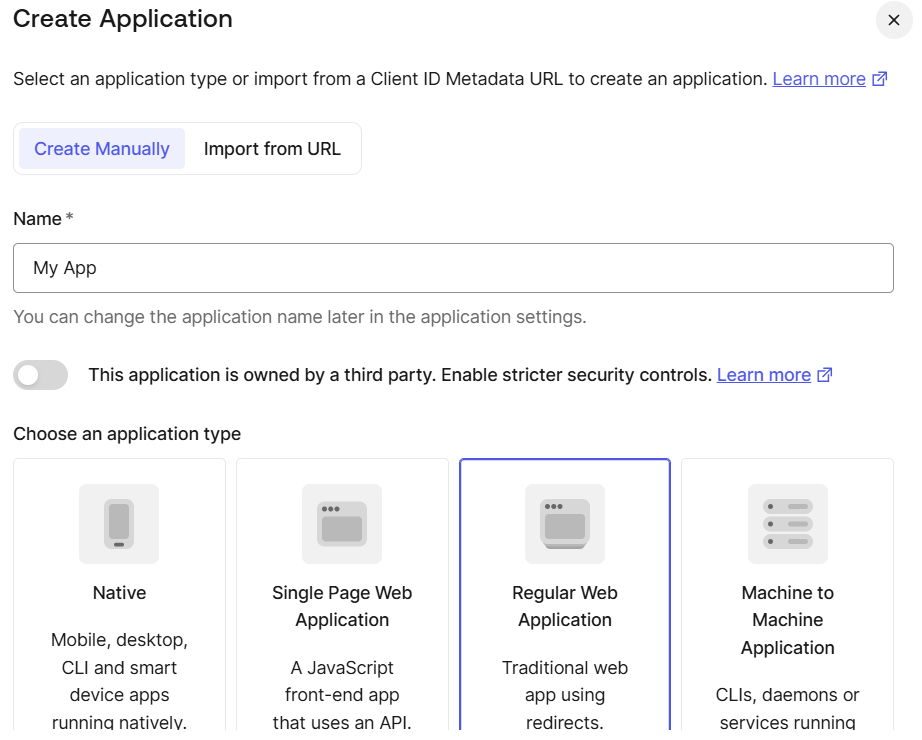 Select Regular Web Application during Creation of new Application
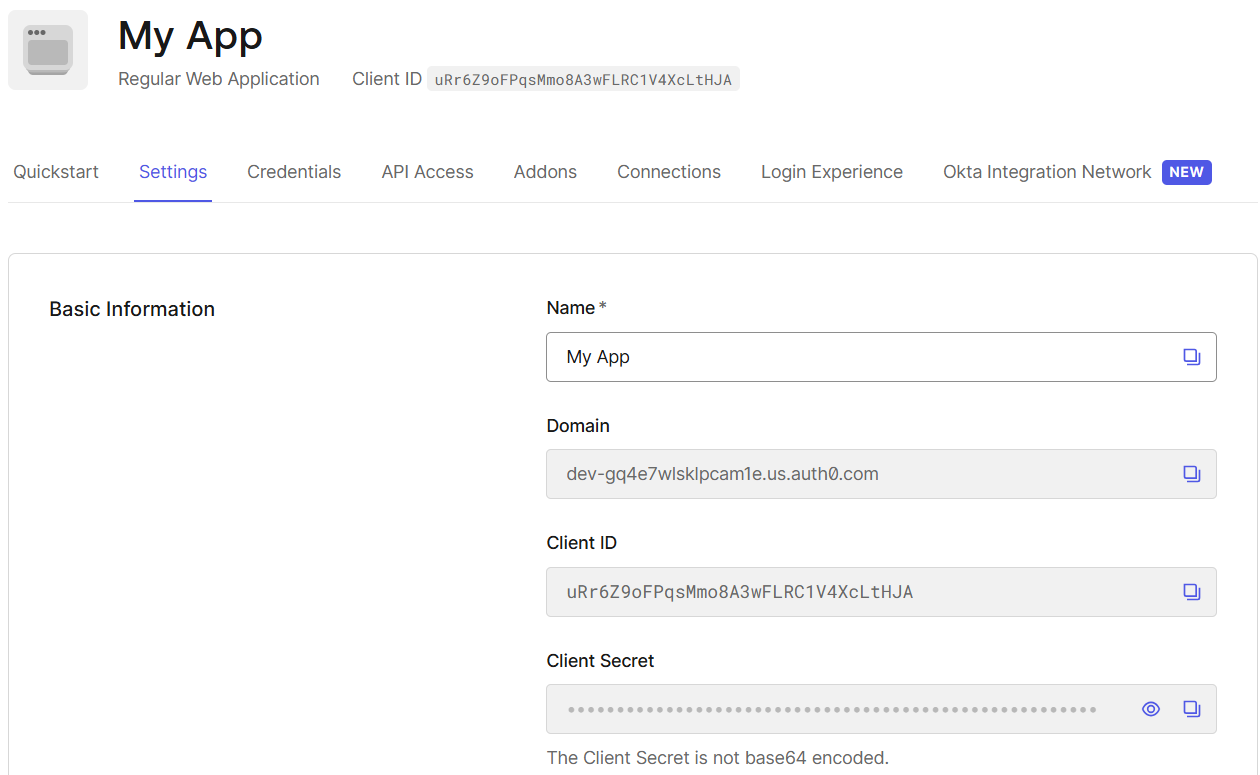 Take note of these values in the Settings tab
You may need to adjust the Allowed URIs/URLs section of your app,
depending on how you setup the Auth0 you may need to add additional pathsThese two are most likely to cause problems during dev-ing time As an example I had the following set as my Allowed Callback URLs:
http://localhost:3000/api/auth/callback
http://localhost:3000/auth/callback
2. Set the appropriate Auth0 secrets in .env.local
1
2
3
4
5
APP_BASE_URL=http://localhost:3000
AUTH0_DOMAIN=foobar.auth0.com
AUTH0_CLIENT_ID=REPLACEME
AUTH0_CLIENT_SECRET=REPLACEME
AUTH0_SECRET=REPLACEME
3. Spin up the Node environment via Docker
1
2
3
4
5
6
# Lab URL: https://github.com/kawing-ho/labs/tree/main/nextjs-auth0
git clone https://github.com/kawing-ho/labs.git
mv .env.local labs/nextjs-auth0
cd labs/nextjs-auth0
docker build . -t nextjs-auth0
docker run --rm -p 3000:3000 -v "$(pwd):/app" -v /app/node_modules nextjs-auth0
4. Signup / Login to a fake user account
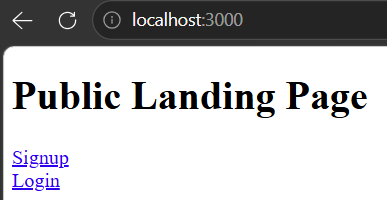 The index page leads to Auth0 signup/login on click
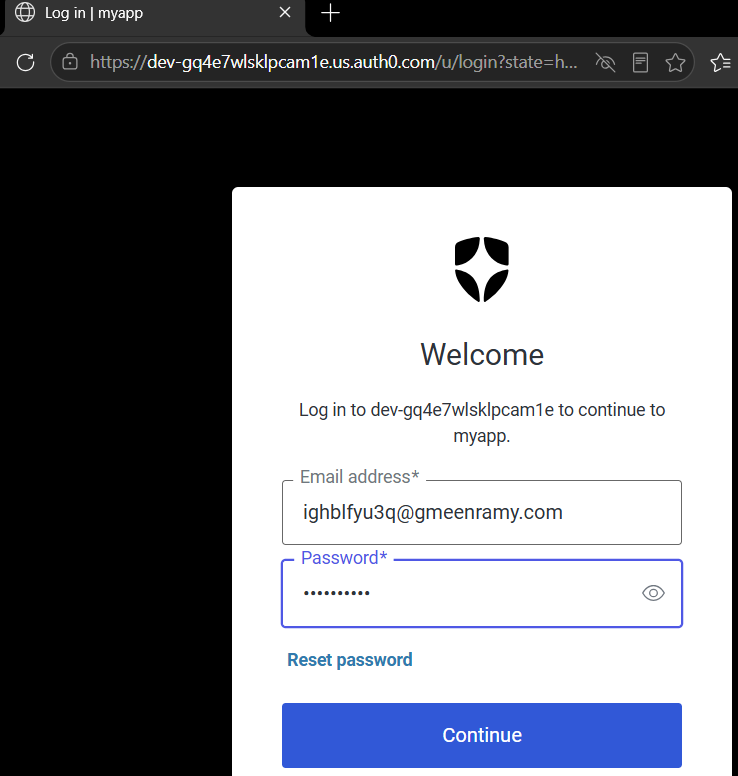 Follow prompts to signup/login which will return to the app upon success
5. Inspect element and observe tokens in HTML
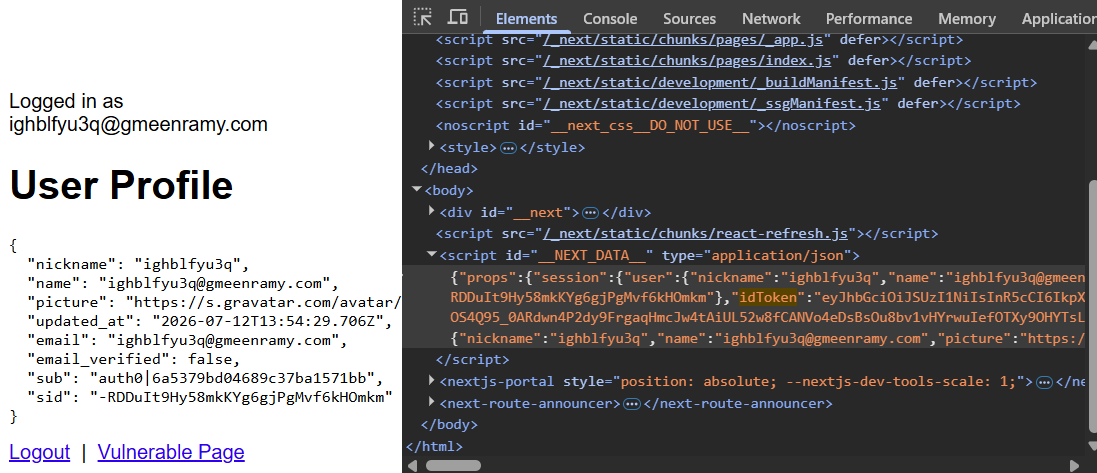
idToken present in __NEXT_DATA__ script block
6. Remove session from return value within _app.tsx
Modify pages/_app.tsx and save changes:
1
2
3
  return { ...appProps, session } // remove 'session'

  return { ...appProps } // fixed
7. Reload pages and observe absence of tokens
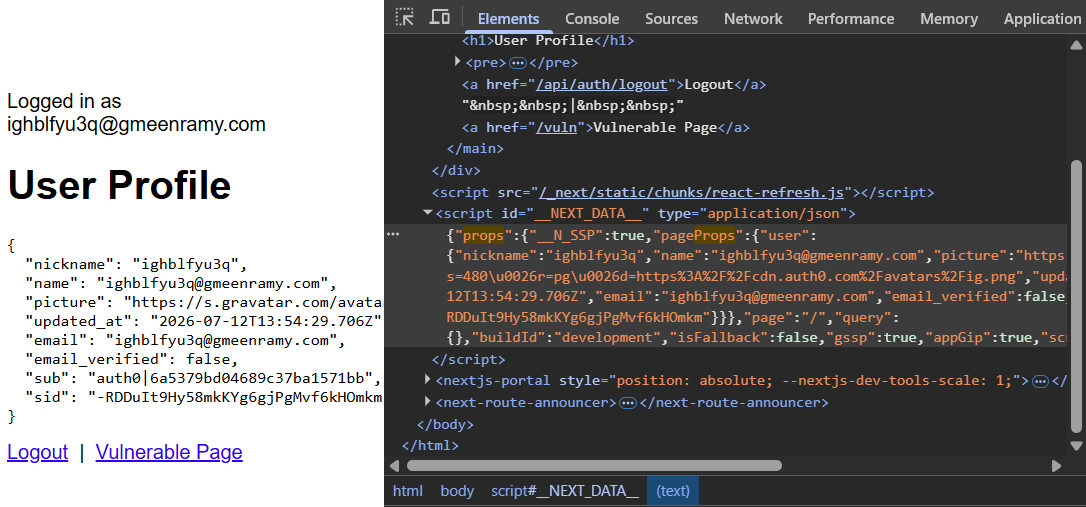 Observe the
 session object is no longer present in the JSON blob
Conclusion
The remediation advice given was to:
- Modify
getInitialPropsto return only the minimum user attributes required by the client-side application (such as display name and permissions), omitting raw session data from the serialised page props.- Since the
sessionobject contains various fields, only the necessary subfields can be passed in as props rather than the entiresessionobject itself.
- Since the
- Retain bearer tokens exclusively on the server side, using the existing Auth0 session cookie mechanism for authentication rather than forwarding tokens to the browser.
- Consider migrating away from the
getInitialPropspattern entirely, as it is a legacy API. Instead, usegetServerSidePropson individual pages, which provides finer-grained control over what data is serialised and avoids application-wide risk.
Same as previously, I hope this post can help bring more awareness to this potential pitfall. If you would like to quickly check your projects, the associated semgrep rule targeted against Auth0 + Next.js is ready to use.